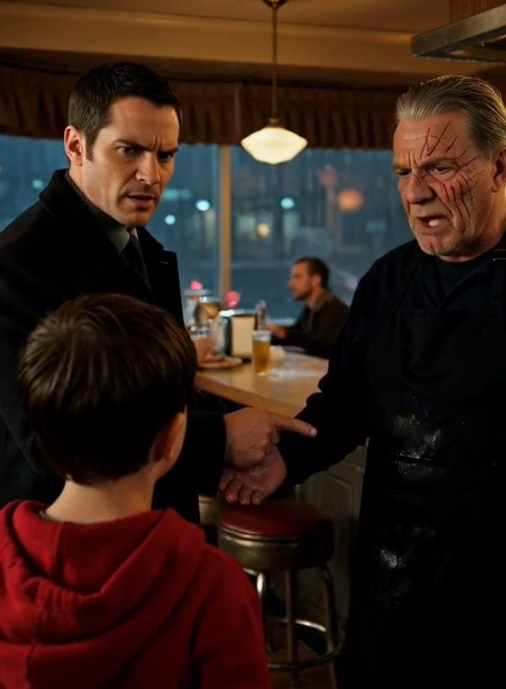
The rain hammered harder against the diner windows, like it was trying to warn someone inside.
The man in the dark coat didn’t step back.
He just looked at the cook.
Then at the boy.
Then at the locked door.
Like he was measuring how long it would take for the situation to stop belonging to him.
The cook didn’t blink.
Not once.
“You’re making a mistake,” the man said finally, voice lower now. Controlled again. Forced calm.
The cook let out a short breath that wasn’t quite a laugh.
“No,” he said. “The mistake was thinking you’d walk in here and leave the same way.”
The boy’s fingers dug into the cook’s apron from behind.
Small.
Terrified.
But still there.
Still holding on.
A sound of engines rolled through the rain outside.
Not one.
Not two.
More.
The headlights grew brighter through the fogged glass, turning the diner into a glowing box surrounded by movement.
The waitress stepped back from the door lock like it had started to burn her hand.
The man in the coat finally turned his head toward the windows.
For the first time, something in his expression slipped.
Not fear.
Calculation.
“How many did you call?” he asked quietly.
The cook didn’t answer immediately.
He just shifted slightly so the boy was still fully behind him.
Then he said, “Enough.”
A beat of silence.
The trucks outside stopped.
Doors opened.
Footsteps in the rain.
Then shadows moved past the windows—slow, deliberate, surrounding the diner without urgency.
Like they already knew the outcome.
The man in the coat exhaled through his nose.
“You think this is protection,” he said.
The cook tilted his head slightly.
“I don’t think,” he replied. “I remember.”
The boy’s voice trembled again.
“That’s him,” he whispered, pointing at the photo. “That’s the man who took my mom.”
The cook looked down at it again.
At the tied chair.
At the sign.
At the wrist.
That tattoo.
Something old and buried in him shifted.
Not rage yet.
Recognition first.
Then something colder.
He stepped forward.
Just one step.
The man in the coat didn’t move.
“You don’t understand what you’re interfering with,” the man said.
The cook’s voice dropped.
“I understand exactly.”
Another step.
“Twenty years ago,” the cook said, “a man with that mark killed my brother in a place just like this.”
The diner went completely silent.
Even the fridge hummed like it didn’t want to be heard.
The man in the coat stared at him for a long moment.
Then, slowly, he smiled.
Not friendly.
Not warm.
Resigned.
“Then we finally agree on something,” he said.
The cook’s hand moved slightly behind him—shielding the boy more fully.
The waitress whispered, “Police are on the way.”
The man in the coat nodded once.
“So are mine.”
Outside, more engines turned over.
The boy trembled harder.
The cook looked down at him for half a second.
Then back at the man.
And when he spoke again, his voice was no longer just protective.
It was final.
“You should’ve stayed outside.”
The first knock hit the diner door like a gunshot.
And the lock held—for now.