The sirens didn’t feel like rescue at first.
They felt like consequences finally arriving late to a story that had already broken too many people to be cleanly fixed.
I stayed on my knees in the café terrace, Nico still in my arms, his small fingers gripping the back of my shirt like he was afraid I might dissolve if he let go. Elena knelt beside me, her hand pressed against her mouth, trying not to fall apart in public and failing anyway. Daniel stood just behind us, watching the hedge line, scanning the street like a man who had spent too many years expecting pursuit.
The café had become a strange kind of theater. Cups untouched. Chairs half-turned. Strangers pretending not to witness something they would remember for the rest of their lives.
And through it all, the boy — Nico — stayed quiet.
Until he wasn’t.
“Are they going to take me back?” he asked.
His voice wasn’t loud. It didn’t need to be. It cut straight through everything anyway.
Elena shook her head immediately. “No.”
Daniel stepped closer, crouching so he was level with the boy. “No one is taking you anywhere you don’t choose.”
Nico looked at him like he wanted to believe it, but didn’t yet know how.
That was when I noticed his hands.
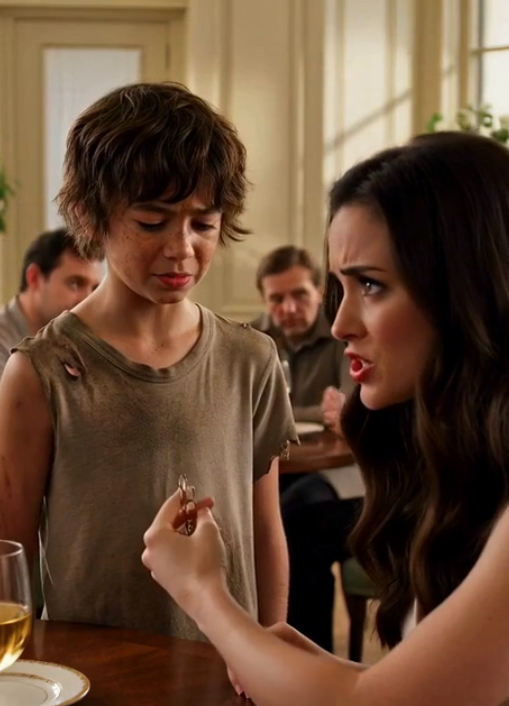
Small. Cold. Still holding the bent hair clip case like it was the only proof he had ever been allowed to carry.
My throat tightened again.
“Where did you keep this all this time?” I asked softly.
Nico glanced down. “Mom gave it to me before they separated us. She said if I ever found you, I should show it before I said anything else.”
Elena made a sound like she’d been hit by something invisible.
“I didn’t separate from him,” she whispered. “I hid him.”
Daniel’s jaw tightened. “Because of your father.”
She nodded.
The words hung there — not accusation anymore, just history too heavy to rewrite.
A shadow fell across the terrace as the first officers reached the café entrance.
People shifted. Someone stood too quickly. A chair scraped.
But Daniel didn’t move.
He looked at me instead.
And for the first time since I’d seen him alive again, his voice softened.
“Do you want me to handle this?” he asked.
It should have been a simple question.
It wasn’t.
Because it meant: Do you trust me after everything that was taken from you? Do you still believe I’m on your side?
I looked at Nico again.
At his face. At the way he kept leaning toward me even while scared. At the quiet certainty in him that I was not a stranger, even if the world had tried to make me one.
Then I looked at Elena.
At the years carved into her eyes.
At the guilt she had carried like a second skin.
At Daniel — who had died in one version of my life and chosen exile in another.
And I realized something that made my chest ache in a different way.
This wasn’t a moment of reunion anymore.
It was a moment of repair.
“Not alone,” I said finally.
Daniel nodded once.
Elena wiped her face and reached for Nico’s shoulder.
And together, we stood.
When the officers arrived at the terrace, they didn’t find panic or running or denial.
They found a child holding a bent silver clip.
A woman who had been told too many false endings to accept another one.
A man who had already buried himself once and refused to do it again.
And a sister who had spent twelve years turning survival into secrecy.
Daniel spoke first.
“I called you,” he said. “Not for a disturbance.”
He looked at Nico.
“For him.”
The lead officer hesitated, eyes moving between us.
“What’s the situation?”
I tightened my hand around the hair clip without realizing it.
Then I answered, steady enough that it surprised even me.
“The situation,” I said, “is that someone tried to erase our family.”
A pause.
Then, quieter:
“And failed.”
Behind me, Nico squeezed my hand for the first time on his own.
Not from fear this time.
From choice.